Oracle published a build-along last week: Build a Self-Improving Second Brain on Oracle AI Database. It is a good piece of work. Your content, its embeddings, and your agents' memory in one database. Semantic search with the embedding model running inside the engine. A synthesized wiki that recompiles itself. An MCP server so the brain is reachable from Claude, ChatGPT, or your phone. Four kinds of agent memory, each in its own table. All of it runnable on a free local container, with a genuinely free cloud path if you want it always-on.
I want to be clear about what it is before I say what it is not. It is a developer tutorial showing what a converged database can do, written by a product marketing director and a developer advocate. It is not a research position paper, and it would be unfair to review it as one.
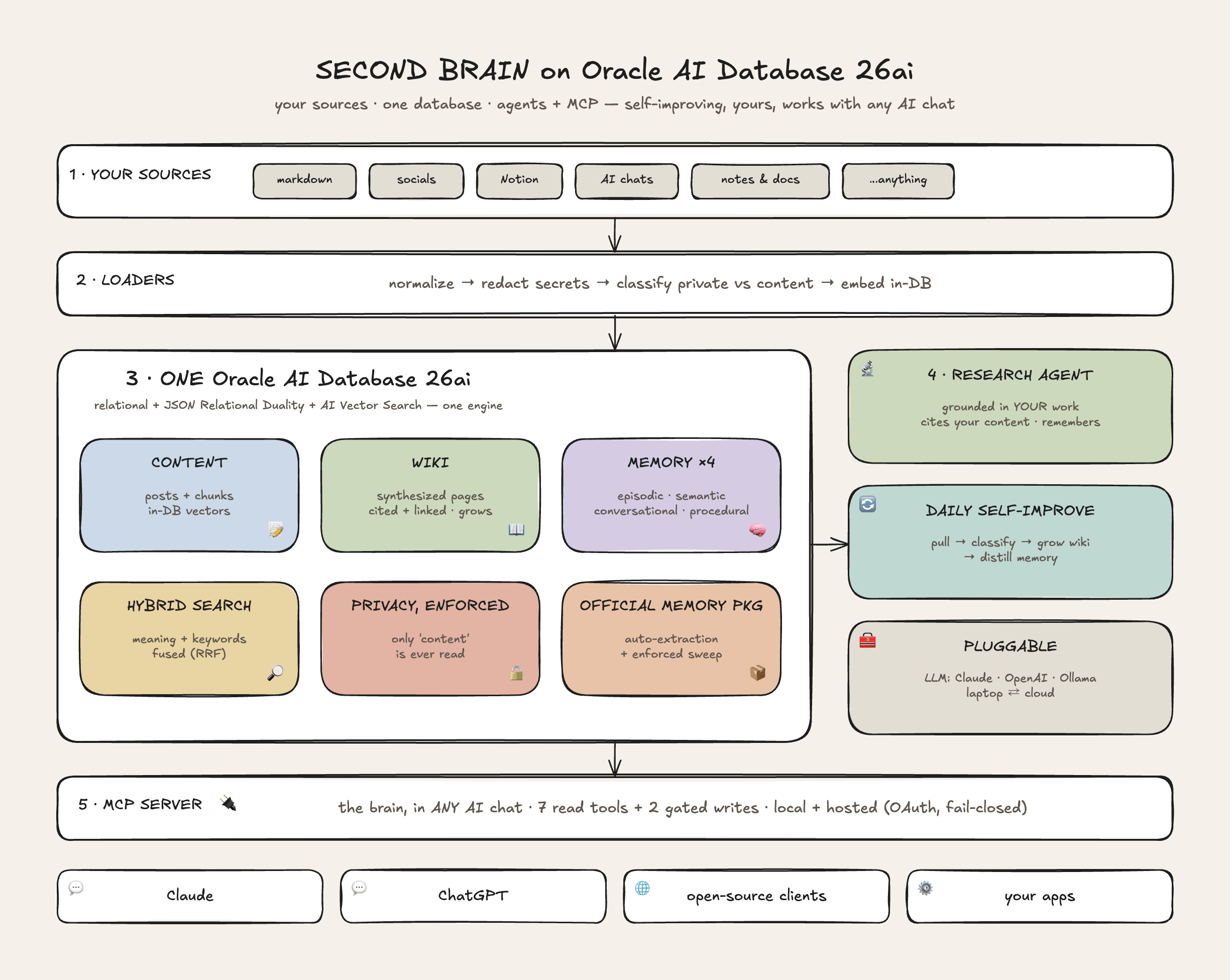
The build, on one page. Diagram by Oracle, from the original post.
But it contains a sentence that is worth stopping on, because it is the whole argument of this piece:
> "One scheduled job enforces the order pull sources → classify → refresh the wiki → consolidate memory, so your synthesized pages and learned facts never go stale."
That promise is real. The system delivers it. And it only covers half of what "stale" means.
The first meaning: out of sync with a source
This is the meaning Oracle solved, and solved well.
You publish a new video. You edit a note in Obsidian. You add a client to Notion. The derived layers - the embeddings, the synthesized wiki pages, the distilled facts - were built from an earlier version of that material, and now they lag behind it.
The fix is a scheduled re-derivation. Pull the sources, classify what came in, recompile the wiki, consolidate memory. Because every derived layer is a pure function of the current sources, re-running the pipeline makes the derived state correct again by construction. Their privacy model rides on the same insight: a visibility column is enforced on every read path, so private material is excluded from search, from the wiki compiler, and from memory consolidation. As they put it, the brain "can't quietly re-derive it into durable memory after you've set it aside."
That last part deserves credit, because it is more than access control. It is a rule about what the system is permitted to come to believe. That is the right shape of thing. It is the shape I think the whole problem needs. It just happens to be pointed at privacy, which is one dimension of a larger question.
The reason this approach works is an assumption sitting quietly underneath it: the sources are the authority, and memory is downstream of them. Memory can always be rebuilt, because there is a truth to rebuild it from.
The second meaning: it was true, and now it is not
Here is the case that assumption does not cover.
A fact enters durable memory. Not scraped from a document - distilled from work. The client's approval threshold is fifteen thousand. The migration is scheduled for Q3. This customer segment does not respond to email. Each was true when the system learned it. Each was learned correctly.
Then the world moves. The threshold changes. The migration slips. The segment starts responding to email because someone fixed the sender reputation.
Now re-run the pipeline. Pull the sources, classify, refresh the wiki, consolidate memory. What happens to the old fact?
Nothing happens to it. There is no source that contradicts it, because the source it came from - a conversation, a decision, a piece of completed work - has not changed. That conversation still happened. The decision was really made. The document still says what it said. The fact is not out of sync with anything. It is simply no longer true.
Re-derivation cannot fix this, because re-derivation restores consistency with the sources, and the sources are consistent. The system is working perfectly and holding a false belief.
This is what my paper on persistent expert memory called stale truth reuse, and it sits alongside two siblings: identity drift, where the system stops answering as the same expert, and contradiction persistence, where two incompatible beliefs coexist because nothing ever adjudicated between them. None of the three is a retrieval failure. Retrieval works. That is what makes them hard to see.
Why "self-improving" is the interesting word
The Oracle build describes its agent as improving through accumulation. Every research run writes to agent_memory - question, outcome, sources, lesson. Durable facts get distilled into semantic_memory. As the article's takeaways put it, the agent and future agents "become more useful as the user adds more material."
For retrieval, that is straightforwardly true. More material, better coverage, better answers.
For a system expected to hold a durable position over years, accumulation is not obviously improvement. A system that keeps distilling confident conclusions, with no rule for what supersedes what, does not converge on truth. It accumulates well-argued statements that increasingly disagree with each other, all of them citing real sources, all of them plausible. The failure does not announce itself. Nothing errors. The answers just get subtly less trustworthy while the memory table gets bigger.
Their four memory types - episodic, semantic, procedural, conversational - are the standard taxonomy from the agent-memory literature, and they say so plainly. It is a taxonomy of where things are stored. What my paper argued for is a different cut: layers defined by how much authority a belief carries and how it earns or loses that authority. Temporal fact memory, where a fact is marked current, historical, superseded, or disputed. Governed promotion, where entering durable memory is a gated event rather than a side effect of having been mentioned.
Those two models look similar from a distance. They answer different questions. One asks where a memory lives. The other asks whether the system should still believe it.
The quadrant this lands in
I wrote in an earlier piece that memory systems differ on two axes: whether they are bounded to a domain, and whether content enters durable memory through governed pathways or accumulates automatically.
A personal second brain is unbounded and auto-accumulating, and that is the correct design for what it is. It ingests your whole life. Coverage is the value. A wrong entry costs little, because it is one of thousands and you are the one reading the output. You will notice.
The trouble starts when that architecture gets pointed at a different job. The same stack - one database, in-DB embeddings, MCP access, four memory tables, a daily consolidation loop - is exactly what someone builds when a client asks for an expert system in a narrow domain. The tutorial is a personal tool. The pattern is a template. And in the bounded-domain quadrant, the economics of being wrong invert: when a client-facing system retrieves a wrong fact as though it were authoritative, someone acts on it.
That is the neglected quadrant I keep meeting in the wild. Bounded domain, weak governance. A specialist system that confidently accumulates unvetted conclusions inside its declared expertise. It looks like an expert. It drifts like a generalist. Nobody designed its memory at all - they inherited it from a tutorial that was solving a different problem well.
What I do not know yet
Everything above is an argument from reading their architecture, and an argument is worth less than a measurement.
The honest position is that I have read the article, the companion repository, and the architecture docs, and I did not find a mechanism for conflict resolution, supersession, or decay. The words do not appear. "Stale" appears four times and means out-of-sync-with-source every time. But not finding something in documentation is weak evidence. Systems have behaviours their docs do not describe, and Oracle's default backend uses their own maintained memory package with automatic extraction, which may do more than the tutorial explains.
So the next step is to stop arguing and run it.
Their whole build runs locally, on a free database container, and with LLM_PROVIDER=ollama it runs at zero cost with no accounts anywhere. That makes this testable by anyone, including me. I am going to stand it up, give it facts that later become false, and report what the memory tables actually hold and which version the agent believes. Not a thought experiment. The real system, their code, with the receipts.
If it handles supersession, I will say so plainly, and I will have learned something about my own paper. If it does not, that is not a criticism of a good tutorial. It is the map of where the hard part starts.
Either way, that is a field report, and it is coming.