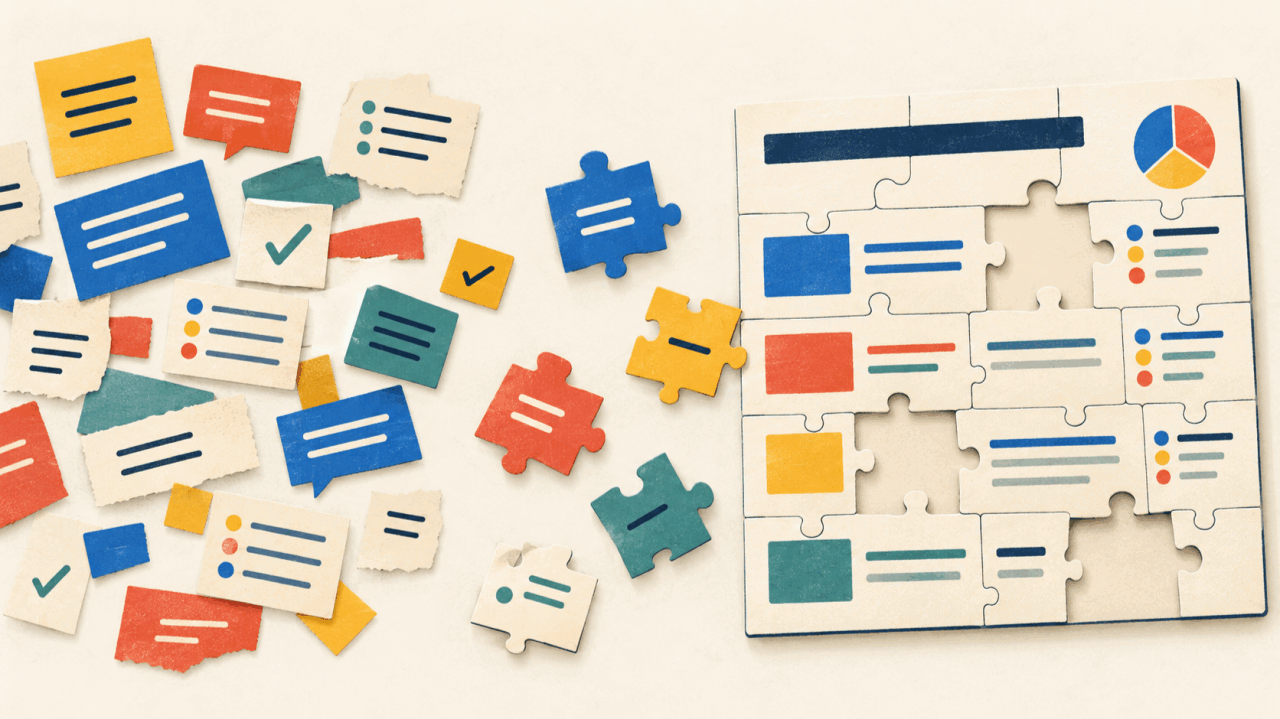
Before Listspace, my projects lived in lists. A text file on my laptop, a list on my phone, a sticky-note app, and a few more that started as temporary and stayed. One big mess, if I am fair about it. I always knew where everything stood, but keeping all those lists current cost me time I would rather have spent on the work.
When a client asked where we were, I wrote an email. A short one, high level, from memory. On some projects I kept a Google Doc instead and shared it with the client, which came closest to what I wanted: one place, readable by both of us. But every line in it was updated by hand, after the work, whenever I remembered. I could have connected Claude to that document and let it do the updating. I never did.
I wrote last week about the Friday hour at my agency, when the board said Monday and the week had to be put back together before anyone could report on it. That was not a quirk of one agency. It is what happens to almost every status update, and the reason is structural.
It is not only me
Surveys put numbers on this. In Asana's Anatomy of Work surveys of 2019 and 2021, knowledge workers say about 60% of their day goes on work about work: status updates, searching for information, shifting priorities. In Wellingtone's State of Project Management 2026, 72% of project professionals say they spend half a day or more each month collating reports.
Both come from companies that sell into this problem, and the people who answered chose to take part. So read the numbers as what people say about their own week, not as a measurement. The pattern behind them is familiar to anyone who has run a project. Doing the work is one job. Reporting on the work is a second one, and nobody budgets for it.
Why the update is a rebuild
The update takes long because the record is kept by hand, after the fact. The work happens in one place and the record sits in another. Nobody moves the item when the work starts, because the work is more urgent than the board. By the time someone asks for status, the board shows what was planned, and the update means working out what actually happened from memory, old threads and commits.
A better template does not change that, and neither does a stricter rule about updating the board every day. The record falls behind for as long as keeping it is a separate job from doing the work.
That is the whole argument, and it points at one fix. The record has to be written by whoever does the work, at the moment the work is done.
The board that moves with the work
For years that fix was not available, because the person doing the work was a person, and people under pressure skip the admin. What changed is where the work happens. Much of mine now happens in a chat with an AI, and that chat already knows what was done, because it did it or watched me do it.
So I built Listspace around that. When a chat starts, the AI reads the project board. While we work, it moves items as they start and finish, adds a short comment on what was done, puts new requests on the board when they come up, records what was decided, and leaves a summary at the end of the session. Every change shows who made it, me or which AI.
I have used it on all my projects every day for over a month now, and it changed how my work feels. Decisions are on the board, and tasks get added and updated without me touching them. When a client wants to know where things stand, the answer is a board, not an email I write from memory.
What is left is a check
When status is asked for now, there is nothing to rebuild. The board is already where the work ended, and what is left for me is reading it and checking whether it is right. Most of the time it is. Sometimes I correct an item or add the context a chat could not know.
That last part is where the method has its edge. The board is exactly as current as the share of my work that happens in a chat. A decision made on a phone call, a promise made over coffee, a change agreed in a hallway: none of that reaches the board unless someone carries it there. The share keeps growing, which is why the board keeps getting truer. It will never be all of it, and the part that stays outside is often the part that matters most to the client.
So the second job did not disappear. It shrank to the conversations that happen away from a screen, and those still need a person who writes them down.