Every agency owner I talk to about AI gets to the same question within ten minutes: which tools should we buy?
It is the wrong question, and one sentence shows why. Your competitor can buy the same tools. Whatever subscription you are evaluating, the shop across town is evaluating too. The models are rented, identical, and available to anyone with a credit card, which makes them the one part of your AI capability that cannot set you apart.
The better question is the inversion. What do we have that they cannot buy?
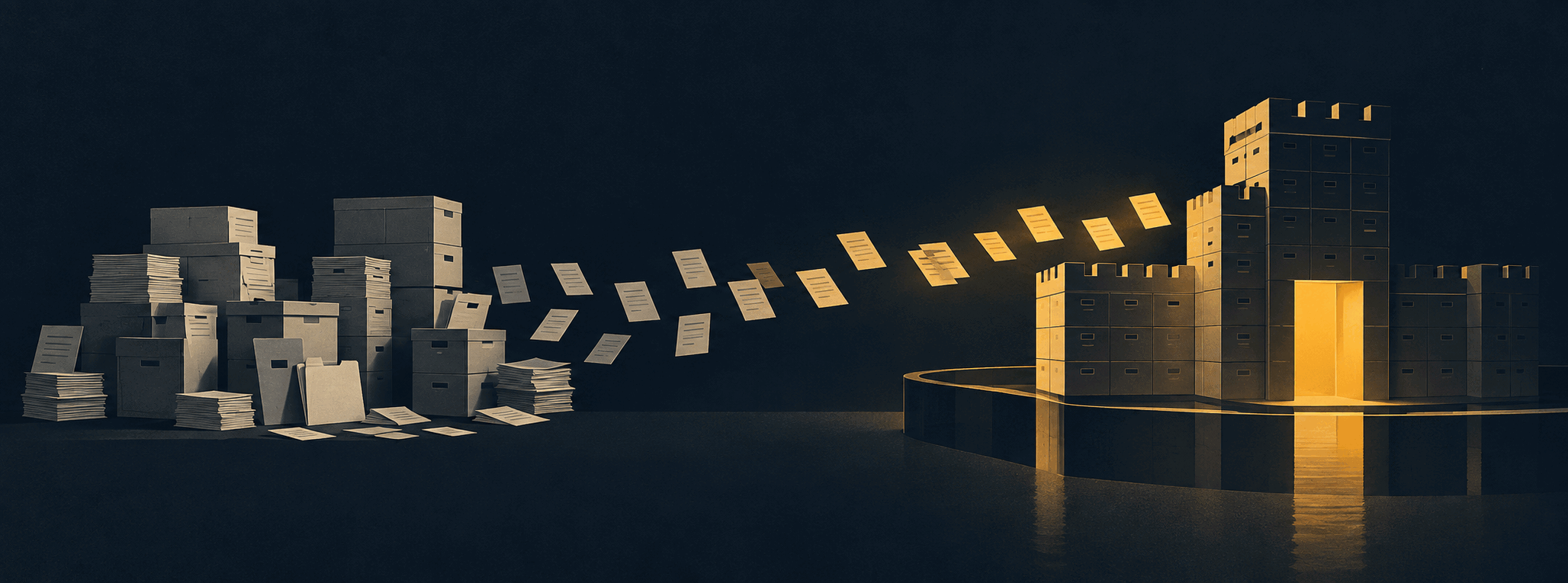
For an agency that has been around a while, the answer has been piling up for a decade on a server nobody opens. Every brief you ever received. Every deliverable that answered one. Every proposal, won and lost. Every scope document next to what the project actually took. Every email thread where a client explained, in their own words, why round two was better than round one.
We had all of that at This Page Amsterdam. Twelve years of it, thirty people's worth, stored and backed up and never once read as a whole, because nobody could. It was thousands of files written for humans, at a volume no human would ever re-read. We treated it as a storage cost. It was the most valuable thing we owned, and we did not know it, because there was no way to use it.
What the folder actually contains
Read those files as data instead of clutter and they change shape.
Every project is a matched pair: what was asked, and what good looked like in response. Hundreds of worked examples of your agency's judgment, in your niche, in your voice. No competitor has these. No model was trained on them.
The proposals, won and lost, are your fit rubric, written by accident one deal at a time. The pattern in what you won, what you lost, and what you should never have pitched is in that folder waiting to be read.
Every estimate next to what the project really took is calibration data, the exact input you need to stop margin leaking at the quote, which is where agency margin has always leaked.
The distance between draft one and the approved version, repeated across years, is your quality bar, demonstrated rather than described. Clients even annotated it for you, for free, in the comments.
And the post-mortems and the war stories are the judgment layer: what went wrong, what the tell was, what you would never do again.
None of this was usable before, and that is the point of this piece. The archive was always valuable in theory and inert in practice. What changed is not your archive. Language models made unstructured archives computable. A decade of PDFs and email threads went from dead weight to raw material, and you did nothing to make it happen.
I did it to my own archive first
Before I built this for anyone else, I built it for myself, on smaller piles.
Fifteen hundred bookmarks I had saved on X over the years and never reopened became a tool I can ask questions of. Hours of podcast episodes became transcripts I can search for the one thing a guest said that I half remembered. A year of my own posts, with their numbers, sits in a calendar that an AI assistant can read when I ask what worked. None of that is agency work. The mechanics are identical: a pile of things written for humans, too big to re-read, made readable by a machine.
This year CULT Collective in Canada asked for the agency version. Their brand-measurement methodology had lived for years in decks, in documents, and in the heads of the people who ran it. The build turned it into a working product that scores what the method was designed to score. I supplied the engineering. Everything that made the product theirs rather than generic, the method, the categories, the judgment about what counts, came out of what they already had. A competitor with the same model and the same budget could not have built it, because the fuel was not for sale.
Follow the competitive logic. Everyone's AI now runs on the same rented engines, so the differentiating input shifts entirely to context: what the system knows that only you could have given it. A generic model drafts a generic proposal. The same model, given your fifty best proposals in this niche and the brief-and-deliverable pairs behind them, drafts something a competitor's identical subscription cannot produce. Not because the model is better. Because the fuel is.
I wrote last month about the founder's head being the agency's real operating system, the place where standards and decisions actually live. That was about judgment. This is about evidence: the record of everything that judgment produced over the years, which is the only training material for your way of working that exists anywhere.
It is also what makes owned tools worth owning. A screening tool built on generic criteria is a subscription with your logo on it. The same tool built on your ten years of won-and-lost is intellectual property.
What to do, and the instinct to resist
The wrong instinct first, because it is the expensive one: "train our own model". Nobody at agency scale needs to, the economics rarely work, and it misunderstands where the value sits. In the builds I have done, the archive's value came out through two boring mechanisms.
Retrieval: the right past work, surfaced at the working moment. The three relevant case studies appearing while the proposal is being drafted. The last four projects of this shape, with their actuals, appearing while this one is being estimated.
Extraction: patterns pulled from volume and written down as rules. The fit rubric mined from won and lost. The quality bar mined from revision histories. The estimate-loading rules mined from scope versus actual. An owner can describe fifty of those judgments from memory. The archive holds five thousand of them.
The first thing I do with a client is one afternoon of inventory: what exists, where it lives, what format it is in, and the question owners tend to skip, which is what they are contractually allowed to reuse. Client work sits under client agreements, and confidentiality survives the project. Much of the archive's value is extractable in anonymized, pattern-level form, since estimate calibration does not need the client's name, but that is a deliberate pass, not an assumption. I would not let a tool touch anything before that question is answered.
And one discipline from the builder's side, because it saves the whole project: an archive is raw material, not memory. It contains your old positioning, your superseded pricing, your abandoned methods, truths that were right then and are wrong now. Value comes from curation, from what gets promoted into the tools and the rules, not from accumulation. Hoarding with a search bar is not an asset. It is a liability with good retrieval.
The quiet advantage of having been around
The part I find encouraging for the established shop, in a moment when everything seems to favor the AI-native newcomer, is this. The newcomer can buy every tool you can. They cannot buy ten years of briefs, deliverables, revisions and post-mortems in your niche. For once, having existed is the advantage, the one input to this whole technology wave that compounds with age and cannot be subscribed to.
Your people can leave. Your tools are shared. Your archive is yours, and as of about two years ago, it is finally legible.