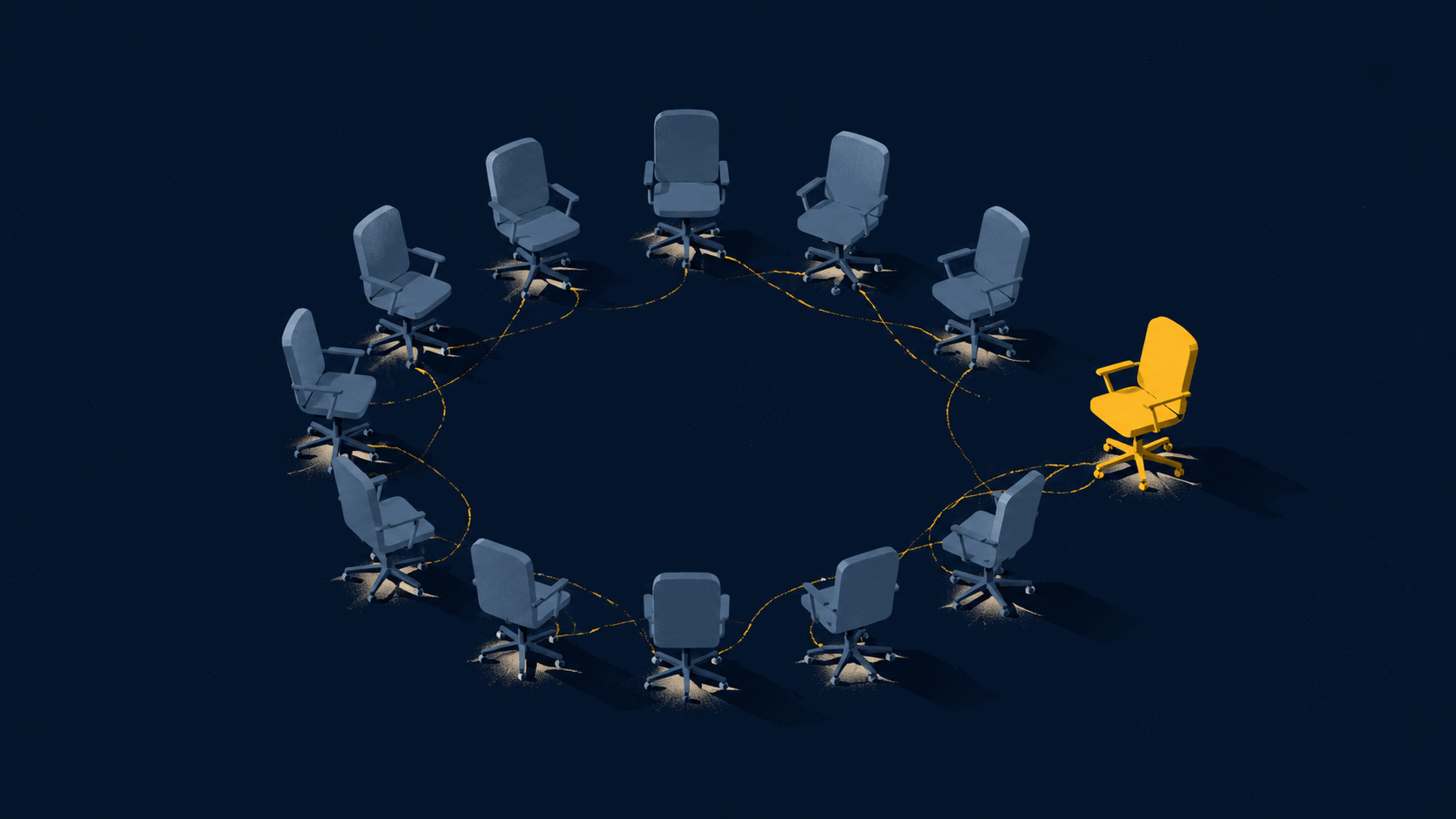
My agency had thirty people. My current company has one person and more chairs than the agency ever had.
At This Page Amsterdam, the chairs were occupied by humans. When I needed the finance view, I walked over to the person who lived in the numbers. When a campaign needed positioning, someone whose whole job was positioning picked it up. Production, design, development, project management, sales, office management: each function was a desk, and each desk was a person who thought about that function all day, every day, for years.
Running Yellow House Digital, I sit on every one of those chairs myself, usually before lunch. AI made that possible in a way that would have sounded absurd when the agency was running. The model writes most of the code I ship. It drafts marketing copy, builds financial projections, reviews contracts, structures research, prepares outreach. Every chair has hands now. One person really can run a portfolio of products, client work, and two partnerships at once, and I am the existence proof I would not have believed in 2019.
That is the part everyone can see, and it is the part the AI conversation loves. The catch took me longer to find, and I have not seen anyone price it in.
The hands and the head
Every chair in a company has two parts. The hands do the work of the seat: the spreadsheet, the copy, the code, the deck. The head knows what the seat is for: the question that chair exists to keep asking, whether or not anyone wants to hear it.
A finance chair is not spreadsheets. It is the person who asks "can we afford this" while everyone else is excited. The marketing chair is not copy. It is the person who asks "why would a stranger care" about the thing the builders love. The sales chair asks "who pays, and when". The production chair asks "what did we actually promise". At the agency, those questions got asked because entire salaried humans existed to ask them, and they asked them at moments when I did not want to hear them, which is precisely when the questions earn their money.
AI fills the hands completely. It fills the head not at all. The model builds me a beautiful financial projection the moment I ask for one. It has never once interrupted my enthusiasm to ask whether the plan survives contact with the numbers. Asking is not its job. Asking was the chair's job, and the chair is now me.
The chair I avoid
This is where it stops being a framework and becomes a confession.
I sit in some chairs naturally. The product chair and the developer chair fit me so well I have to be dragged out of them. Give me a judgment call about what to build, what not to build, which idea goes in the folder of things I will never make, and I am home.
Marketing, I avoid. A few of the things I have built over the last year are live and deliberately unmarketed, and I have told myself a story about each one. With thirty people, my avoidance had a limit: the person in that chair kept working whether I engaged or not. Alone, the chair only works when I sit in it, and I quietly do not.
AI makes that avoidance easier, not harder, and this is the mechanism I think solo operators should watch closely. The empty chair no longer looks empty. Output exists: drafts get written, plans get generated, the folder of marketing material grows. Every seat produces artifacts, so every seat feels occupied. Occupancy is not output. Occupancy is the question getting asked at the uncomfortable moment, and no artifact ever asked me anything.
The org chart moved inside
What I now understand is that AI did not eliminate my org chart. It collapsed the payroll and moved the org chart inside one head.
All the functions still exist. All the questions still need asking. The disciplines a thirty-person company distributed across thirty nervous systems now have to be scheduled inside one, and the scheduling is the actual job. Not the doing: the doing is increasingly handled. The job is knowing which chair this moment requires, sitting in it fully, asking its question with a straight face, and then standing up before the next chair's question gets missed too.
Twelve years of agency life turn out to be the qualification I did not know I was earning. I watched real people hold each of those chairs. I know what a good finance head sounds like when she pushes back, what a good salesperson does with silence, what a producer's face looks like when the scope has drifted. When I sit in those chairs now, I am imitating specific humans, and the imitation only works because I sat near the originals for years.
That is the quiet requirement underneath the whole solo-with-AI story, and it is the reason the story is less repeatable than it looks. The tools gave me every seat in the company. Knowing what each seat is for came from somewhere else, took a decade, and did not come with the subscription.
Originally published on LinkedIn.