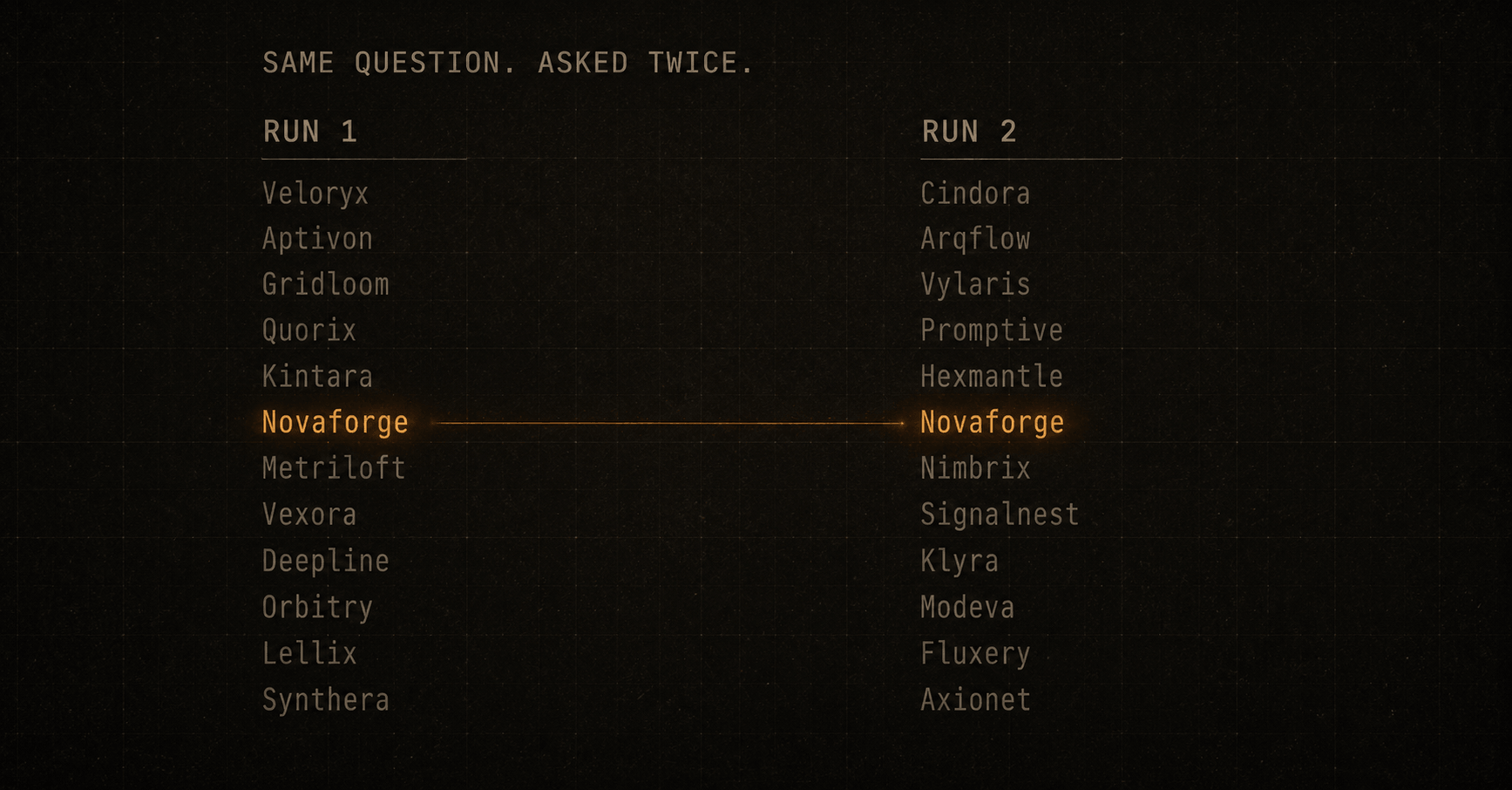
First run of a recurring measurement. Figures and funding numbers are as of July 2026.
The AI-visibility industry raised a lot of money this year. PromptWatch closed EUR 6 million, twelve months after launch. Peec raised $29 million. Profound raised $58 million more on top of a unicorn valuation.
The bet behind all of it is simple: your next customer asks ChatGPT who to hire, and being in that answer is the new being on page one.
I think the bet is right. I had a different question. What do the answers actually look like?
Not the score. Not the trend line. The answers themselves, in the words a buyer would actually read.
The instrument
I built the small version. It is deliberately unsophisticated, and that is most of the point.
A frozen panel of twenty questions, fired once a month at OpenAI, Anthropic and Perplexity through their APIs, with web search available, every question asked twice in fresh contexts. Every raw answer stored verbatim. The first run produced 120 responses and cost about $9.
Frozen, because a panel that changes month to month cannot show you movement, only noise. The panel is versioned: this run used v1, the twenty questions below. It has since gone to v2, at twenty-two. Any edit mints a new version, so a run always says which panel it was asking.
Asking twice is the part that matters most, and it is the part a dashboard cannot do for you. One answer tells you what a model said. Two answers, asked identically, tell you whether the model is saying anything stable at all.
Here is the panel, since a measurement you cannot inspect is not worth much.
Buyer questions. The things someone looking to hire actually types.
- Who builds custom AI tools for marketing agencies?
- Best freelance AI developer for a small business
- How much does a custom GPT for my business cost?
- Best way to automate lead qualification for a service business
- Who can build an MCP server for my SaaS?
- AI developer for agencies UK
- Custom AI tool development Mérida Mexico
- Best AI automation consultant for agencies under $10M
- Who should I hire to check if my website is readable by AI?
Practitioner questions. The things people already inside an agency ask.
- How do I stop AI content sounding generic?
- Should agencies still bill hourly if AI makes delivery faster?
- What should an agency automate first?
- How do I check a website brief for scope risk before quoting?
- How do agencies write an AI policy for clients?
- How do I prove the ROI of an AI tool to my boss?
- How do I get my business recommended by ChatGPT?
Tripwires. Four questions designed to catch the models answering when they should not. Two ask about real but obscure technical topics. Two ask about terms I coined, which exist in essentially one place on the internet each. I am not naming those two here, because a tripwire stops working the moment you publish it, and the panel is frozen.
What the first run showed
Three things, none of which I have seen on a dashboard.
The answers are a lottery
The same question, asked twice in fresh contexts, returned mostly different company names.
Question one, who builds custom AI tools for marketing agencies. OpenAI's first pass named Exponent Marketing & AI, AI Ops, Buildberg, Flowwork, MV Beat, Automello, Alethia, Relevate.ai, Iverton AI, Apexium. Its second pass, same question, named ZTABS, Buildberg, Makeitfuture, GOFTUS, VIXI Agency, ReplyAgent, D50 AI, Launched, FusionSync, UseCortana, AgencyOS, The Infoage Solutions. One company survived both runs. One.
Question six, AI developer for agencies UK. Anthropic's first pass named eight companies: Clutch.co, Notch, DesignRush, IIH Global, Hyperlink InfoSystem, Coding Sprint, Digica, Pixelette Technologies. Its second pass, identical question, named nobody at all. Not a different list. No list.
Perplexity was the steadiest of the three, returning near-identical lists on several questions. That is worth saying, because it is the one result pointing the other way.
There is no stable ranking underneath most of this. A visibility score without a variance number is describing a coin flip to two decimal places. It is not that the score is wrong, exactly. It is that a single number implies a stability the underlying answers do not have, and the number cannot tell you that, because the number is what is hiding it.
Being read is not being named
The providers consulted sources heavily and surfaced almost none of them in what the user actually sees.
Perplexity cites, which is its whole product. OpenAI and Anthropic mostly do not. On question one, OpenAI's two runs cited nine and ten domains respectively while naming over twenty companies each. Anthropic, answering the same question twice with search enabled, cited nothing visible at all while still producing a confident list of named companies.
That gap is the thing to understand, and it is easy to miss because both halves feel like the same event. Crawler hits on your site mean an AI looked at you. They do not mean it recommended you. Those are different numbers. Most of the work of getting recommended lives in the space between them, and nothing in your server logs will tell you where you sit in that space.
The models skip the web more than you would think
On practitioner questions, the how-to questions rather than the who-should-I-hire questions, the models mostly did not search at all.
How do I stop AI content sounding generic: OpenAI answered from memory both times. Should agencies still bill hourly if AI makes delivery faster: OpenAI, both times, no search. What should an agency automate first: OpenAI no search both runs, Anthropic no search both runs. How do I prove the ROI of an AI tool to my boss: OpenAI and Anthropic both answered from memory, twice each. Only Perplexity searched consistently across this group.
The implication is uncomfortable if you are publishing in order to be found. Whatever you publish cannot reach an answer that never looked. Publishing more does not help when the question does not trigger retrieval in the first place, and which questions trigger retrieval is not something you control.
On the tripwires
Two of the twenty questions ask about terms I coined. They exist, as far as I know, in one place on the internet each.
One of them came back named correctly by OpenAI on both runs, with my own name attached and a citation pointing at the single source. The model had found the one place the term existed and reported it as established fact. Anthropic, asked the same question, confidently returned a real but entirely unrelated product with a similar name. Perplexity returned a scattering of unrelated pages.
Three providers, one invented term, three different failure modes. The first found the only source and treated it as authoritative. The second pattern-matched to something adjacent and answered anyway. The third returned noise. None of them said they did not know.
The tripwires are the cheapest part of the panel and possibly the most informative part of the run.
What this does not mean
None of this means the tools are wrong to exist. At scale, across many brands and many categories, a platform is the right buy, and the funding says plenty of companies agree. Aggregation has real value, and I am not running twenty questions across four hundred clients.
It also does not mean my instrument is better. It is twenty questions and about $9. It has no history, no cross-category comparison, and no way to tell whether July was normal. One measurement is not a trend. This run establishes a baseline and nothing more.
What it does mean is narrower. One month of raw answers taught me more about how this actually works than a score would have, because the raw answers show you the variance and the score hides it. If you are trying to understand the mechanism rather than track a metric, the receipts are more useful than the dashboard.
Measure first. Buy the dashboard later, if the dashboard is still what you need once you have seen what is underneath it.
What happens next
The panel stays frozen and the instrument runs again. I will publish what it finds, including the runs that show nothing interesting, because a measurement you only publish when it is flattering is not a measurement.
The sixteen questions above are the ones I thought a buyer or an operator would actually ask. If you think they are the wrong ones, or there is a question missing that would change what this measures, I would be glad to hear it. The panel is frozen, not finished.
Correction: the run cost originally stated ($11.50) was the instrument's own estimate; reconciling against provider billing puts it at about $9. The cost meter has since been fixed to bill-exact.
Originally published on LinkedIn.